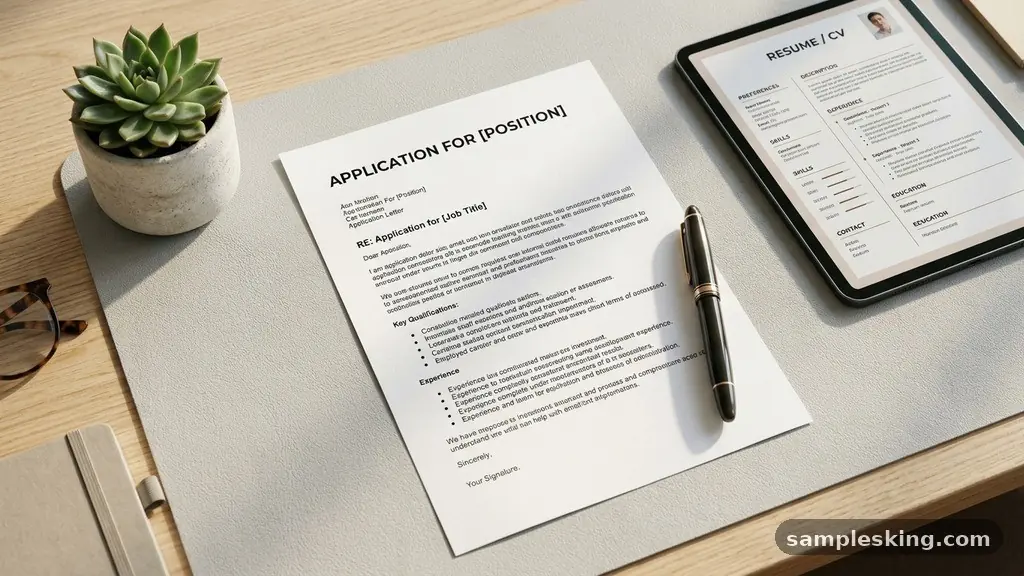
Finding a professional job application letter sample with a simple writing guide is often the first step toward landing your next role. Many candidates struggle to bridge the gap between their resume and the specific needs of a potential employer. By focusing on your unique value proposition rather than just repeating your work history, you can significantly increase your chances of securing an interview request.
This article provides the structural foundation and actionable advice you need to craft a compelling narrative. You will learn how to align your experience with a job description while maintaining a professional tone that resonates with a busy hiring manager.
Anatomy of an Effective Application Letter
The most successful letters follow a predictable but powerful structure that respects the reader’s time. You should always include your contact information at the top, followed by the date and the recipient’s details. If you have the name of the hiring manager, use it; a personalized greeting is far more effective than a generic “To Whom It May Concern.”
The opening paragraph must hook the reader by stating exactly which position you are applying for and why you are interested. Avoid vague statements about wanting to grow; focus instead on what you bring to the table.
Your middle paragraphs serve as the core of your argument, where you connect your past achievements to the company’s current needs. This is the place to highlight specific, measurable results rather than just listing duties. Use the body of the letter to expand on your most relevant experience.
By linking your background directly to the requirements in the job description, you make it easy for the recruiter to see you as a solution. Keep your paragraphs concise and focused on one specific accomplishment or skill set per block.
Standard Formatting and Professional Tone
Consistency in your document design reflects your attention to detail. Use a standard, clean font like Arial, Calibri, or Times New Roman, and ensure your margins are set to one inch on all sides. Your letter should ideally fit on a single page, meaning you should aim for 250 to 400 words total.
If you are submitting your document through an online portal, be mindful of any specific formatting standards requested by the company. Some systems use an applicant tracking system to scan for keywords, so mirroring the language found in the job advertisement is a smart tactic.
Maintaining a professional tone requires a balance between confidence and humility. Avoid overly aggressive language or flowery adjectives that cloud the message. Instead, let your accomplishments speak for themselves through clear, active verbs.
Every sentence should serve a purpose, whether it is demonstrating your technical expertise or showcasing your soft skills. Proofread your work multiple times to ensure there are no typos, as errors can undermine your credibility before the hiring manager even finishes the first paragraph.
Drafting Your Value Proposition
Your value proposition is the unique combination of experience, skills, and personality that makes you the ideal candidate. You must articulate how you will solve the problems the company is currently facing.
Think about the challenges mentioned in the job description and frame your previous roles as evidence of your ability to tackle those specific issues. If a company is looking for someone to streamline their operations, describe a time you reduced overhead or increased efficiency by a specific percentage.
Focusing on transferable skills is essential if you are changing industries or moving into a new functional area. You might not have the exact job title the company is looking for, but you likely possess the underlying competencies required to succeed. Highlight your ability to learn quickly, adapt to new software, or lead cross-functional teams.
By centering your narrative on your capacity to deliver results, you shift the focus from what you want to what you can provide. This mindset creates a much more persuasive argument for why you should be hired.
Using a Concrete Application Example
To help you visualize the process, consider the following structure. This template provides a baseline for your own writing while allowing room for your personal voice.
- Header: Name, phone number, email, and LinkedIn profile link.
- Salutation: Dear [Hiring Manager Name], or “Dear Hiring Team,” if the name is unknown.
- Introduction: State the position and express enthusiasm for the company’s specific mission.
- Body Paragraph 1: Connect a major career achievement to the primary requirement of the job.
- Body Paragraph 2: Discuss your soft skills, such as communication or leadership, using a brief example.
- Closing: Reiterate your interest and include a clear call to action regarding an interview.
This structure ensures you cover all the necessary bases without rambling. Remember that the goal is to make the hiring manager’s job easier by giving them a clear, concise reason to move your application to the next stage.
Comparing Traditional and Modern Approaches
The way we apply for jobs has shifted significantly over the last decade. While the core components of a letter remain, the delivery and stylistic expectations have evolved to suit digital environments.
| Feature | Traditional Approach | Modern Approach |
|---|---|---|
| Delivery | Physical mail or PDF | Direct upload or email body |
| Tone | Formal and rigid | Professional and conversational |
| Focus | Career objective | Value proposition |
| Length | Always one full page | Concise, scannable blocks |
The shift toward modern practices means you should prioritize readability. Hiring managers often skim documents, so using short paragraphs and clear, direct language is more effective than writing lengthy, dense prose.
The Role of Keywords and ATS Compatibility
Most mid-to-large companies now use an applicant tracking system to filter candidates based on specific criteria. If your application lacks the keywords found in the job description, it may never reach a human reader. Analyze the job posting to identify the top three to five skills or qualifications they emphasize.
Weave these phrases into your letter naturally, ensuring they appear in the context of your actual work history. Do not simply list them at the bottom, as this can look robotic and dishonest.
For further reading on how to optimize your professional materials, you can consult the CareerOneStop resources provided by the U.S. Department of Labor. They offer excellent guidance on tailoring your documents for different industries.
Remember that while keywords are important for the machine, the letter itself is for the person. Write for the human first, and then ensure the keywords are present to satisfy the software. This dual-purpose strategy maximizes your reach and your impact.
Developing Your Soft Skills Narrative
Soft skills are often the deciding factor when two candidates have similar technical backgrounds. Communication, emotional intelligence, and problem-solving abilities are vital in almost every workplace. Instead of just stating that you are a “team player,” describe a situation where you mediated a conflict or helped a colleague meet a deadline.
Concrete examples carry much more weight than generic buzzwords. A hiring manager wants to know how you operate in real-world scenarios, not just what you claim to be.
These skills are particularly important for leadership and client-facing roles. If you are applying for a management position, emphasize your experience in mentoring, conflict resolution, and project coordination. If you are in a technical field, show how you explain complex data to non-technical stakeholders.
By painting a picture of your daily interactions, you help the hiring manager envision you as a colleague. This creates a psychological connection that encourages them to reach out for an interview.
Mastering the Call to Action
The conclusion of your letter is your final chance to make a lasting impression. Do not simply state that you look forward to hearing from them. Instead, express confidence in your ability to contribute to their team and invite them to discuss your qualifications further.
A strong call to action is polite, direct, and forward-looking. It signals that you are ready to move to the next step of the process and are eager to prove your value in an interview setting.
Keep this section brief and professional. You might say, “I am eager to discuss how my experience in project management can help your team reach its Q4 goals.” This shows that you have done your research and are focused on the future.
Avoid being overly demanding or pushy; maintain a respectful tone that acknowledges the hiring manager’s time. A well-crafted closing leaves the reader with a positive, professional image of you as a candidate who is both prepared and proactive.
Frequently Asked Questions
Should I include a resume summary in my application letter?
Yes, a brief resume summary or a high-level overview of your career objective can be very effective. It gives the reader a quick snapshot of who you are before they dive into the specific details of your experience.
How do I find the name of the hiring manager?
Check the company’s website, search for the department head on LinkedIn, or call the company’s HR office to ask who is overseeing the role. If you absolutely cannot find a name, “Dear Hiring Manager” is the standard, safe choice.
What if I don’t have enough experience for the job?
Focus on your potential and your transferable skills. Highlight relevant projects, volunteer work, or academic achievements that demonstrate you have the capacity to learn the specific tools or processes the company uses.
Is it okay to use a template for my letter?
Templates are helpful for structure, but you must customize them. A generic, copy-pasted letter is easy to spot and often gets rejected because it lacks the specific connection to the company’s mission and the job description.
How long should my letter be?
Keep it between 250 and 400 words. Anything shorter might feel incomplete, and anything longer will likely lose the hiring manager’s attention.
Closing Thoughts
Crafting a successful document is about more than just filling in the blanks. It requires a thoughtful approach where you clearly articulate your value and show how you fit into the specific team you are applying to join. By following this job application letter sample with a simple writing guide, you can create a piece of professional correspondence that stands out in a crowded market.
Focus on your achievements, keep your language clear and concise, and always tailor your message to the specific needs of the company. With these steps, you are well-positioned to land the interview you deserve. Take the time to refine your narrative, proofread carefully, and confidently send your application to the next great opportunity on your horizon.