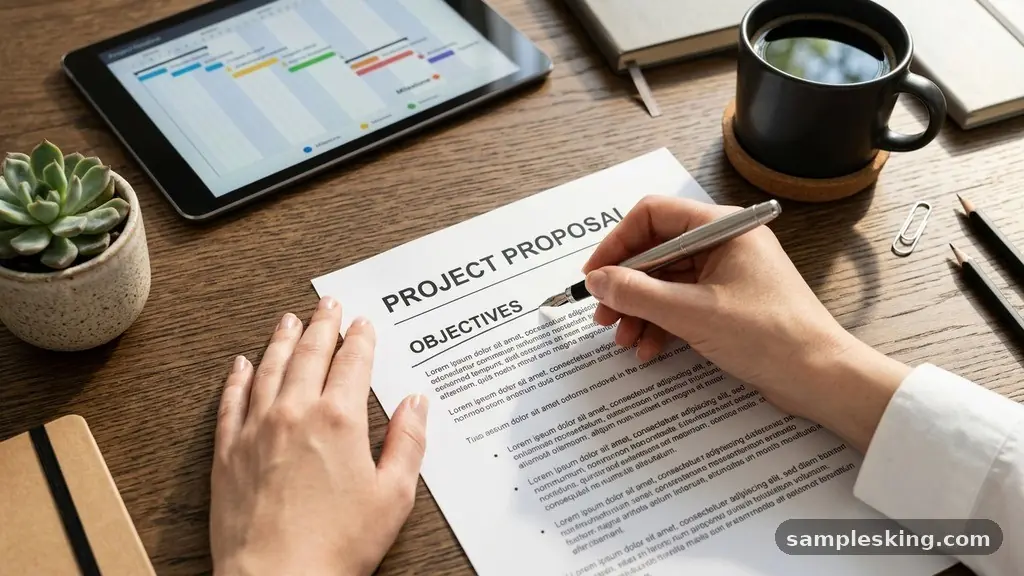
Finding effective project proposal samples for students and beginners can significantly reduce the anxiety associated with academic or entry-level professional planning. A well-structured proposal serves as your roadmap, ensuring that your goals are clear and your path to completion is logical.
By examining proven templates, you learn how to articulate complex ideas without getting lost in unnecessary jargon. This article provides the foundational knowledge needed to build a winning submission, helping you turn abstract concepts into actionable plans that impress teachers or project leads.
The Core Components of a Successful Proposal
Every professional project proposal, regardless of the industry, relies on a specific set of building blocks. You should start with a clear problem statement that defines the issue you intend to solve.
This section must be concise, focusing on the “why” rather than the “how.” If the evaluator cannot grasp the necessity of your work within the first few sentences, they are unlikely to read further.
The next critical element is the project scope. This defines the boundaries of your work, explicitly stating what you will do and, just as importantly, what you will not do.
Beginners often make the mistake of over-promising, which leads to burnout and failure. By clearly outlining the scope, you manage expectations and protect yourself from “scope creep,” where the project grows beyond your initial capacity.
You must also include a section on methodology. This describes the specific steps, tools, and processes you will use to achieve your goals.
Whether you are conducting a survey, building a software prototype, or writing a literature review, your methodology needs to be defensible. It demonstrates that you have thought through the logistics and have a realistic plan for execution.
Drafting an Effective Executive Summary
The executive summary is the most important part of your document because it is the only section some busy stakeholders will actually read. Despite appearing first, you should write this section last. It must synthesize your entire proposal into a single, cohesive narrative that highlights the core objectives and the expected benefits.
Think of this as your “elevator pitch.” It should be no longer than one page and should cover the problem, your proposed solution, and the anticipated outcome.
Avoid using overly technical language here. The goal is to make the project sound both essential and achievable to someone who may not be an expert in your specific niche.
When refining this section, focus on the impact. Why does this project matter right now?
If you are submitting this for a class or a grant, emphasize the unique value your approach brings to the table. A strong summary creates a positive first impression that encourages the reader to trust your competence for the rest of the document.
Setting SMART Goals and Objectives
Defining your project objectives requires precision, which is why the SMART acronym is so valuable for students. SMART stands for Specific, Measurable, Achievable, Relevant, and Time-bound.
If your goals do not meet these criteria, you will struggle to track your progress effectively. A vague objective like “improve student engagement” is far less powerful than “increase student participation in weekly forums by 20% by the end of the semester.”
You can use the following table to compare poorly defined objectives with refined, SMART versions to see the difference in clarity and accountability.
| Vague Objective | SMART Objective |
|---|---|
| Write a report on climate change. | Complete a 15-page analysis on urban heat islands by December 1st. |
| Improve app speed. | Reduce database query response time by 300ms by Q3. |
| Study local history. | Interview 10 local residents and transcribe their oral histories by June. |
By focusing on these metrics, you provide yourself with a clear yardstick for success. When you know exactly what “done” looks like, you can allocate your time and energy more efficiently. This discipline prevents the frustration of working hard without seeing tangible results.
Developing a Realistic Timeline
A project without a timeline is just a wish. For students and beginners, creating a visual schedule is the best way to stay on track.
A Gantt chart is a standard tool for this, as it allows you to see the overlap between different tasks and identify potential bottlenecks. Even a simple spreadsheet can serve as a functional Gantt chart if you list tasks in rows and dates in columns.
When building your timeline, always include a buffer period. Unexpected issues—such as a missing data set or a delayed response from a partner—are almost guaranteed to happen. If your schedule is packed too tightly, a single day of delay can cause a cascade of missed deadlines.
Break your project down into milestones. These are major checkpoints that signal you are moving in the right direction.
Celebrating these small wins keeps your motivation high during long projects. It also provides an easy way to update your supervisor or teacher on your progress without needing to explain every minor detail.
Managing Your Project Budget
Budget estimation is often intimidating for beginners, but it is a fundamental skill in any professional environment. Even if your project does not involve actual cash, you are likely spending resources like time, software licenses, or travel. You need to account for these costs to show that you are a responsible planner.
Start by listing every resource required to complete your deliverables. This includes physical items like printing costs or specialized equipment, as well as digital assets like paid subscriptions or data analysis software. If your project is internal or academic, you might also assign a “time cost” to tasks to understand the human resource allocation required.
* Direct Costs: Materials, software, or travel expenses.
* Indirect Costs: Electricity, workspace, or administrative overhead.
* Contingency Fund: A 10-15% buffer for unforeseen price hikes or emergencies.
* Resource Allocation: Who is doing what and for how many hours?
Being transparent about your budget shows that you respect the resources provided to you. It also prevents you from starting a project you cannot afford to finish. If your proposal requires external funding, this section is where you demonstrate the return on investment for the sponsor.
Performing a Comprehensive Risk Management Plan
Risk management is the art of preparing for what might go wrong. Beginners often skip this section, thinking it sounds pessimistic, but experienced project managers know it is a sign of maturity. You need to identify potential threats to your success early so you can build in safeguards.
Common risks for student projects include technical failure, lack of access to participants, or sudden changes in project scope. For each risk, create a brief mitigation strategy.
For instance, if you rely on an online survey, your risk might be a low response rate. Your mitigation would be to have a backup plan, such as conducting in-person interviews if the digital response is insufficient after one week.
You do not need to overcomplicate this. A simple list of “Potential Risk” and “Mitigation Plan” is usually sufficient for most proposals.
Showing that you have anticipated these hurdles gives your audience confidence that you are prepared to handle adversity. It proves that you are not just a dreamer, but a practical problem-solver.
Utilizing Evaluation Criteria
How will you or your stakeholders know if the project was a success? Evaluation criteria are the standards by which you measure the final output.
These should be directly linked back to your initial objectives. If your goal was to reduce app load time, your evaluation criteria would be the speed test results gathered after the final deployment.
Sometimes, evaluation is qualitative. If you are running a community workshop, your criteria might be participant satisfaction scores or testimonials.
You should define these methods of measurement before you start the project. This ensures you collect the right data throughout the process rather than scrambling for evidence at the end.
For further reading on how professional organizations structure these assessments, you can visit the Project Management Institute. They offer extensive resources on standard evaluation frameworks used in the industry. Understanding these professional standards can help you elevate the quality of your own academic or entry-level proposals.
FAQ: Common Questions on Proposal Writing
How long should a typical student project proposal be?
Most proposals for school or introductory work should be between three and five pages. Keep it concise, focused, and free of fluff to respect the reader’s time.
What if I don’t have all the information yet?
It is perfectly acceptable to state your assumptions. Just be transparent about what you know and what you still need to investigate during the project.
Should I include graphics in my proposal?
Yes, visuals like charts, tables, and project timelines are excellent. They make your document more scannable and break up long blocks of text.
What is the most common mistake beginners make?
The most common mistake is poor planning regarding the timeline. Most beginners underestimate how long tasks take, leading to rushed work at the end.
Do I need to include a bibliography?
If your proposal relies on secondary research, you absolutely should include a list of references. It adds credibility and shows you have done your homework.
Final Thoughts on Proposal Success
Mastering the art of writing project proposal samples for students and beginners is a skill that will serve you throughout your career. By focusing on clear objectives, realistic timelines, and thorough risk assessment, you distinguish yourself as a thoughtful and organized individual. These documents are more than just academic requirements; they are the blueprints for your future achievements.
Remember that every proposal is a living document. It is okay to adjust your plans as you learn more during the execution phase. The most important thing is to start with a solid foundation and remain adaptable as you move forward.
As you practice these techniques, you will find that your ability to persuade others and organize your work improves significantly. Use these frameworks as your starting point, and you will be well on your way to project success.