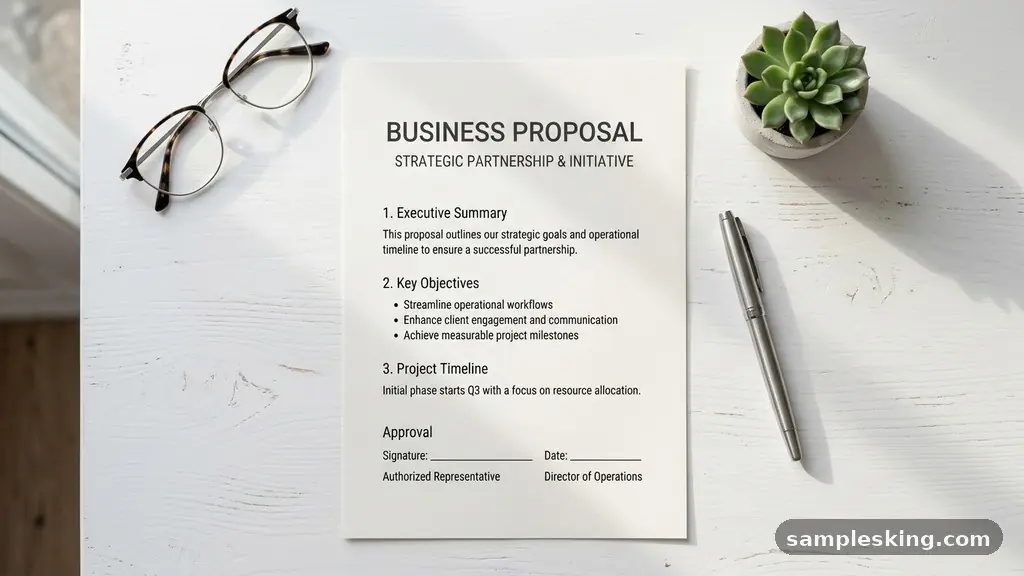
Crafting a professional document that wins contracts doesn’t require complex jargon or dozens of pages. Using a simple Business Proposal Template With a Writing Example allows you to focus on the core value you provide to a potential client. By stripping away unnecessary fluff, you ensure that the decision-maker can quickly identify how you solve their specific pain points.
This approach highlights your efficiency and clarity, two traits that build immediate trust before a contract is even signed. Whether you are a freelancer or a small agency, mastering this concise format will significantly improve your conversion rate and shorten the time spent on administrative tasks.
The Anatomy of a Winning Proposal
A successful proposal is not about the length of the document but the quality of the information provided. You need to balance persuasion with brevity to keep the reader engaged from the first page to the last. Most clients are busy, so they appreciate a layout that respects their time while answering their most pressing questions.
Every effective proposal starts with a clear structure that guides the reader logically toward a decision. You should always include a professional cover letter, a concise executive summary, and a clear breakdown of the work involved. When you maintain a consistent, professional format, you remove friction from the evaluation process.
The following structure works for nearly any industry:
- Cover Letter: A brief, personalized introduction that sets a professional tone.
- Executive Summary: A high-level overview of the problem and your proposed solution.
- Problem Statement: A clear articulation of the client’s current challenges or needs.
- Proposed Solution: A detailed look at how your services will address those challenges.
- Project Scope and Deliverables: A specific list of what you will produce and when.
- Pricing Structure: A transparent breakdown of costs.
- Call to Action: A clear next step for the client to take.
Crafting a Compelling Executive Summary
The executive summary is the most important section of your document. It is where you summarize the entire project in a few paragraphs, emphasizing your unique value proposition. Many clients will read this section first, and some may decide whether to move forward based on it alone.
Avoid summarizing your company’s history or listing your credentials in this section. Instead, focus entirely on the client’s goals and how you intend to help them achieve those results. Keep it focused on the future state they will reach after working with you.
Use this space to mirror the language the client used during your initial discovery calls. If they emphasized the need for speed, mention how your process will accelerate their results. If they focused on cost-efficiency, explain how your solution eliminates waste.
Defining the Problem Statement
A strong problem statement proves that you have listened to the client requirements. It shows that you understand the “why” behind the project, not just the “what.” This section should be empathetic, identifying the specific obstacles preventing the client from succeeding.
Be specific about the symptoms of the problem. For example, instead of saying “your marketing is ineffective,” say “your current lead acquisition process is resulting in a 40% drop-off rate at the checkout page.” Specifics show that you have done your homework.
This is also the place to acknowledge the risks of inaction. When you clearly describe the pain the client is feeling, your solution naturally becomes more attractive. You are not just selling a service; you are selling the resolution of an existing headache.
Structuring Deliverables and Timelines
Clients want to know exactly what they are paying for and when they will receive it. Vague descriptions lead to scope creep and misunderstandings later in the project. Use your simple Business Proposal Template With a Writing Example to provide a clear, itemized list of deliverables.
For each deliverable, assign a clear deadline or project milestone. This provides the client with a roadmap of the engagement. It also helps you manage expectations regarding the project timeline by showing how different phases connect.
When you provide a clear schedule, you demonstrate project management competency. It signals to the client that you are organized and capable of delivering on time. Use a table to make this information as scannable as possible.
| Milestone | Deliverable | Estimated Date |
|---|---|---|
| Phase 1 | Initial Research & Discovery | Week 2 |
| Phase 2 | Drafting & Development | Week 5 |
| Phase 3 | Review & Revisions | Week 7 |
| Phase 4 | Final Delivery & Handover | Week 8 |
Designing a Transparent Pricing Structure
Pricing is often the most sensitive part of any negotiation. By being transparent and organized, you reduce the likelihood of sticker shock. Avoid hiding costs or using vague line items that might confuse the client.
If your pricing is complex, break it down by project phase or service category. This allows the client to see the value associated with each expense. It also gives you leverage to negotiate; if the budget is too high, you can remove specific line items to reach a price point that works for both parties.
Always include a brief note on payment terms, such as deposits or milestone-based payments. Clear communication here prevents cash flow issues later on.
You can find more information on industry-standard billing practices through the U.S. Small Business Administration resource center.
Writing Example: A Practical Application
To see how these elements come together, consider this short example for a web design project. Executive Summary: “We will redesign your landing page to reduce bounce rates by 25% within three months.” Problem Statement: “Your current page takes over five seconds to load, causing potential customers to abandon their carts.”
Proposed Solution: “We will compress all media assets, implement lazy loading, and optimize the checkout flow to reduce friction.” Deliverables: “A fully responsive, speed-optimized landing page, a set of high-conversion copy variants, and an A/B testing report.”
Pricing: “Total project investment is $5,000, payable in two installments of $2,500 at the start and upon final delivery.” Call to Action: “Please sign the attached service agreement by Friday to secure our design team for the upcoming month.”
Handling Terms and Conditions
While a proposal is a sales document, it often serves as a precursor to a formal service agreement. You should include a high-level summary of your terms and conditions to ensure everyone is on the same page. This section doesn’t need to be a full legal contract, but it should cover the essentials.
Mention your policy on revisions, which is a common source of conflict. Be clear about how many rounds of feedback are included in the price. If the client asks for more, you can outline the hourly rate for additional work.
Also, clarify the ownership of intellectual property. Does the client own the final work product once the invoice is paid? Stating this clearly prevents ambiguity and builds professional confidence.
The Role of Stakeholder Analysis
Before you finalize your proposal, think about who will actually read it. You might be sending it to a project manager, but a finance director or executive might also review it. Your proposal needs to speak to the concerns of all these stakeholders.
A stakeholder analysis helps you tailor your message. The project manager cares about the timeline and the deliverables. The finance director cares about the return on investment and the pricing structure.
If you know you are presenting to multiple decision-makers, ensure your executive summary addresses the high-level business impact. Then, provide the technical details in the later sections for the project leads. This multi-layered approach increases your chances of approval.
Frequently Asked Questions
How long should a simple business proposal be?
A simple proposal should generally be between three and six pages. The goal is to provide enough detail to gain trust without overwhelming the reader with unnecessary information.
Should I include a cover letter with every proposal?
Yes, a cover letter is essential. It provides a human connection and allows you to briefly personalize the document for the specific person receiving it.
What if the client asks for a lower price?
When a client asks for a lower price, look at your project scope. You can offer to remove specific deliverables or extend the timeline to reduce costs, rather than simply discounting your work.
How do I write a call to action that gets results?
A strong call to action should be direct and time-bound. Instead of saying “let me know what you think,” say “please sign the attached agreement by Friday to begin the project on Monday.”
Is it better to send a PDF or a web-based proposal?
PDFs are safer and easier for clients to store and share internally. Web-based proposals can offer analytics, but a clean, well-formatted PDF remains the industry standard for professionalism.
Final Thoughts on Proposal Success
Creating a consistent process for your business communications is the best way to scale your operations. When you rely on a simple Business Proposal Template With a Writing Example, you ensure that every document you send out is professional, clear, and persuasive. This consistency helps you build a brand reputation for being organized and easy to work with.
Remember that your proposal is a reflection of how you will handle the actual project. If the document is messy or lacks clarity, the client will assume your work will be the same.
Take the time to refine your template so that it acts as a silent salesperson for your business. Start by drafting your next proposal using the structure outlined above and watch how it improves your client relationships and closing rates.