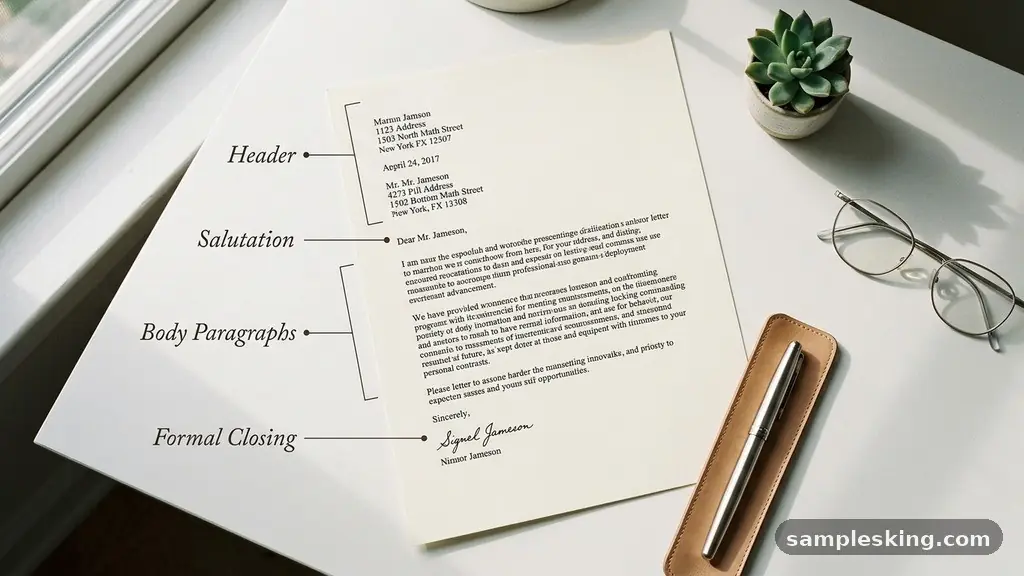
Mastering the skill of writing a Professional Request Letter is essential for anyone aiming to influence outcomes within a workplace or academic setting. Whether you are asking for a salary increase, requesting time off, or seeking a recommendation, the way you construct your message directly impacts the likelihood of a positive response.
By maintaining a formal tone and adhering to a clear document structure, you demonstrate respect for the recipient’s time and authority. This article provides the foundational strategies, formatting standards, and practical examples you need to communicate your requirements with confidence, ensuring your message remains professional, persuasive, and effective.
The Anatomy of a Request Letter
A successful request starts with a rigid but logical document structure. You must begin with your contact information, followed by the date and the recipient’s details.
This layout ensures that the correspondence is easily archivable and identifies you immediately as a serious professional. The subject line acts as your first impression, so it should be descriptive and concise enough to signal the purpose of your letter without requiring the reader to open the attachment or scan the full text.
The core of the letter resides in the body paragraphs. Start by stating your purpose clearly and early; burying the request at the end of a long narrative often leads to confusion or frustration.
Use the opening paragraph to establish the context of your request, such as a recent project success or a specific policy you are inquiring about. Follow this with a brief justification that highlights why your request is reasonable and how it benefits the organization or aligns with company goals.
Finally, your closing statement should be polite yet firm regarding the next steps. Always include a call to action that specifies how you would like the recipient to respond, such as a meeting request or a deadline for a decision.
Professionalism in these communications is defined by how well you balance your personal needs with the needs of the organization. If you want to refine your communication skills further, you can consult resources like the Purdue Online Writing Lab for additional guidance on business writing standards.
Formatting Your Correspondence
Consistent document formatting is the hallmark of a polished professional. You should use a standard font like Arial, Calibri, or Times New Roman, typically set at 11 or 12 points.
Margins should be set to one inch on all sides to allow for readability and potential annotations by the recipient. Align all text to the left; using justified text often creates uneven spacing that distracts from the content of your message.
The spacing between sections is just as important as the text itself. Include a blank line between each paragraph and between your salutation and the body.
This white space allows the reader to digest your points one by one rather than feeling overwhelmed by a wall of text. Consistency in your spacing and alignment indicates that you have taken the time to review your work, reflecting positively on your attention to detail.
| Section | Placement | Purpose |
|---|---|---|
| Header | Top Left | Provides contact details for both parties. |
| Subject Line | Below Recipient Info | Summarizes the request for quick reference. |
| Body | Center of Page | Explains the context, request, and justification. |
| Closing | Bottom Left | Offers a professional sign-off and signature. |
Determining Your Tone and Intent
Maintaining a formal tone is non-negotiable when writing a Professional Request Letter. This does not mean you must sound robotic or overly stiff, but rather that you should avoid casual language, slang, or overly emotional appeals.
Your goal is to remain objective, focusing on the facts of the situation rather than personal grievances or demands. If you are asking for a favor, your tone should be appreciative and respectful of the recipient’s autonomy.
Clarity and conciseness are the primary drivers of success in business correspondence. Before you send your letter, ask yourself if the request can be understood by someone skimming the document in under thirty seconds.
If you find yourself rambling, cut the extraneous details and focus on the “what” and the “why.” A request that is too long often signals a lack of preparation, which may lead the recipient to put your letter aside for later, effectively burying your chances of a quick resolution.
Business etiquette dictates that you should always assume the recipient is busy. By being brief, you show that you value their time as much as your own. When you frame your request, focus on the positive outcome.
If you are asking for a budget increase, frame it in terms of the potential return on investment for the company. This shift in perspective turns a “demand” into a “solution,” which is far more likely to be accepted by management.
The Importance of Proofreading
Never hit “send” without conducting a thorough review of your document. Small grammatical errors or typos can undermine your credibility, making you appear careless or unorganized.
When you are writing a Professional Request Letter, you are essentially asking the recipient to trust your judgment or your work ethic. A clean, error-free document serves as a silent testament to your professionalism and attention to detail.
Proofreading involves more than just checking for spelling. You should read the letter aloud to identify awkward phrasing or overly complex sentences that might confuse the reader. Check that your tone remains consistent from the first paragraph to the last.
Verify that all proper nouns, such as names of managers or departments, are spelled correctly. If possible, have a trusted colleague read your draft to provide an objective perspective on whether your request comes across clearly.
Consider these common errors to avoid during your review:
- Passive voice that makes the request sound weak or hesitant.
- Vague subject lines that fail to state the topic clearly.
- Failure to provide a clear deadline or next step for the recipient.
- Inconsistent font sizes or paragraph spacing that makes the document look messy.
- Overly aggressive language that can be perceived as demanding rather than requesting.
Sample Request Letter for a Salary Review
To understand how these elements come together, consider a request for a salary review. You would start with your header, followed by a clear subject line such as “Subject: Request for Salary Review – [Your Name].”
Your opening paragraph should state that you are requesting a meeting to discuss your current compensation in light of your recent performance and increased responsibilities. Use the second paragraph to provide specific, quantifiable achievements that justify your request.
Avoid comparing your salary to that of your peers, as this can be perceived as unprofessional. Instead, focus on your individual contributions, such as hitting specific targets, taking on leadership roles, or improving departmental efficiency.
The closing paragraph should propose a specific time frame for a meeting, such as “I am available to discuss this at your earliest convenience next week.” This approach respects the manager’s schedule while keeping the momentum of your request alive.
A well-crafted request is not just about the money; it is about showing that you understand your value to the company. If you present your case with data and clear reasoning, you turn a potentially tense conversation into a productive negotiation.
Remember that the goal of the letter is simply to secure the meeting, not to settle the entire negotiation in writing. Keep the letter focused on the “why” so that the “how” can be discussed in person.
Managing the Follow-Up Process
Writing a Professional Request Letter is only the first half of the process. If you do not hear back within a reasonable time frame, you must consider the follow-up.
Business etiquette suggests waiting at least five to seven business days before sending a polite inquiry. Your follow-up should be brief and reference the original letter, ensuring the recipient has all the context they need to respond without having to search their inbox.
If the recipient is busy, they may have simply missed your initial email or letter. Your follow-up should be framed as a gentle nudge rather than an accusation of neglect.
Use phrases like, “I am following up on my previous request regarding [Topic] to see if you have had a chance to review it.” This maintains a professional tone while signaling that the request is still important to you.
Track your requests in a simple log or spreadsheet to keep tabs on when you sent the letter and when you followed up. This prevents you from appearing impatient or disorganized.
If you reach a second follow-up and still receive no response, it may be time to pivot to a different communication method, such as a brief check-in during a scheduled one-on-one meeting. Persistence is vital, but it must always be tempered with professional courtesy.
Addressing Challenges in Communication
Sometimes, you may need to make a request that you know will be difficult or potentially unpopular. In these cases, the structure of your letter becomes even more critical. Start by acknowledging the difficulty of the situation or the constraints the organization is currently under.
This shows that you are a team player who understands the broader context of your request. By demonstrating that you have considered the impact of your request, you lower the recipient’s natural defenses.
If your request is denied, maintain your professionalism in your response. Thank the recipient for their time and consideration, even if the answer was not what you hoped for. This keeps the door open for future requests.
You might also ask for feedback on what would be required for the request to be granted in the future, such as specific milestones or budgetary changes. This turns a “no” into a roadmap for your professional development.
Never take a rejection personally or allow your frustration to bleed into subsequent interactions. A professional reputation is built on how you handle setbacks just as much as how you handle successes.
By responding with grace and curiosity, you demonstrate maturity and a commitment to the organization’s long-term success. This level of emotional intelligence is often what sets high-performing employees apart from their peers.
Common Questions About Requesting
How long should my request letter be?
Ideally, your letter should be no longer than one page. Most requests can be clearly stated and justified within three to four short paragraphs. Brevity shows respect for the recipient’s time and keeps the focus on your main point.
Should I send my request via email or physical letter?
Email is the standard for most modern business environments because it is fast and easy to track. However, if the request is highly sensitive or formal, a printed letter delivered in an envelope can add a layer of gravity and professionalism that an email lacks.
What if I don’t know who to address the letter to?
Research the organizational chart or ask a peer for the correct point of contact. Addressing a letter to “To Whom It May Concern” is often ineffective and can make you appear detached. Always try to find a specific name and title to ensure the request lands on the right desk.
Is it okay to use bullet points in a request letter?
Yes, bullet points are an excellent way to list specific achievements or requirements. They improve readability and ensure that your key points are not lost in long, dense paragraphs. Just be sure to keep the list short and relevant to the main request.
How do I write a request for a recommendation?
When asking for a recommendation, provide the recipient with all the necessary details upfront, such as deadlines and the purpose of the recommendation. Remind them of your specific contributions during your time working together to make the writing process easier for them.
Establishing Professional Communication Habits
The ability to articulate your needs clearly is a skill that will serve you throughout your career. Every time you engage in writing a Professional Request Letter, you are refining your ability to influence and lead.
Start by adopting a consistent format and focusing on the clarity of your objective. By treating every request as an opportunity to demonstrate your professionalism and value, you will find that your requests are met with more attention and respect.
Remember that the goal is not to force an outcome, but to initiate a productive conversation. Use your letters as a way to provide the necessary information for the recipient to make an informed decision. As you practice these habits, you will notice that your communications become more effective and your professional relationships grow stronger.
When you approach every request with a clear intent and a respectful tone, you build a foundation of trust that will support your goals for years to come. Continue to refine your approach, observe the responses you receive, and adjust your style to ensure you are always communicating with purpose and impact.